 Reviews

 Proudly American

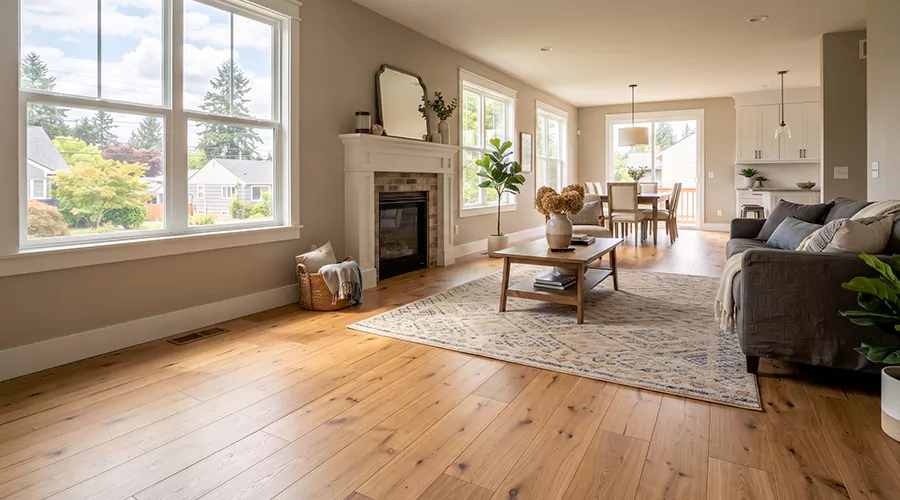
Yes, engineered hardwood floors can be refinished when the real wood wear layer is thick enough, with 2026 refinishing costs commonly around $3 to $5 per square foot. Floors with very thin veneers should not be sanded because the process can expose the core beneath the hardwood surface. If water damage has affected the floor or nearby furnishings, water damaged furniture restoration may also be needed to restore damaged wood furniture.
The National Wood Flooring Association states that engineered wood can be sanded and refinished. However, it cannot normally withstand as many sanding cycles as solid hardwood because only the upper wood layer can be removed.
The key question is therefore not simply whether the floor is engineered. You need to know how much usable hardwood remains above the layered core before deciding between recoating or full refinishing.
What Determines Whether Engineered Hardwood Can Be Refinished?
The thickness of the real wood wear layer is the main factor that determines whether engineered flooring can be sanded. Previous sanding also matters because each refinishing removes some wood. Floor condition and flatness can further reduce how much material is safely available for another sanding cycle.
Engineered flooring usually contains:
- A real hardwood wear layer on top
- A plywood or composite core underneath
- A backing layer below the core
Only the upper hardwood layer can be sanded. Reaching the plywood or composite core permanently changes the visible surface of the plank.
This is the main difference between engineered and solid flooring. Solid hardwood has much more usable wood above its tongue and groove.
If you want to refinish engineered hardwood, wear-layer thickness should be checked before any sanding starts.
How Thick Should the Wear Layer Be for Refinishing?
The NWFA states that a previously finished floor generally should not be sanded when the remaining wear thickness is below 3/32 inch, which is about 2.5 millimeters. Its refinishable certification requires at least 2.5 millimeters for factory-finished smooth engineered flooring. Unfinished smooth products require 3.2 millimeters.
Use this table as a practical guide:
| Wear Layer | Refinishing Outlook |
|---|---|
| Under 2.5 mm | Full sanding generally shouldn't be performed |
| About 2.5 mm | Near the minimum sanding threshold |
| About 3 mm | May have enough material for careful refinishing |
| 4 to 6 mm | Greater refinishing potential |
| Unknown thickness | Measure before sanding |
A thicker wear layer gives the sanding process more margin. It doesn't automatically guarantee several future refinishes.
Floor condition still matters. An uneven surface may require more sanding than a flat floor with light scratches.
The NWFA also notes that the number of sanding cycles depends on wear-layer thickness and equipment. Floor flatness and existing condition also affect the result.
How Can You Check the Wear Layer Yourself?
You can often estimate wear-layer thickness by finding an exposed edge of a plank rather than sanding the visible floor. A floor vent or transition area may reveal the flooring profile. Product paperwork can provide an even better answer when the original manufacturer and flooring model are known.
Try these checks in order:
- Remove a floor register where engineered flooring has been cut around the opening.
- Look at the exposed edge of the plank.
- Identify the real hardwood layer above the core.
- Measure the hardwood layer carefully.
- Check a doorway transition if no vent is available.
- Look for installation records or leftover flooring boxes.
- Search the original product specification when the model number is known.
Do not measure the entire plank thickness and assume that number represents the wear layer. A thick engineered plank can still have a thin hardwood veneer.
Previous sanding makes measurement more important. The original specification tells you how thick the layer was when new, while the current exposed edge shows what may remain today.
What Signs Suggest an Engineered Floor Can Be Refinished?
Engineered flooring is a better refinishing candidate when damage remains near the surface and the boards are still stable. Deep structural problems change the decision because sanding cannot correct delamination or major moisture damage. Enough wear layer must also remain after any previous refinishing work.
Look for these signs:
- The finish looks dull across large areas.
- Surface scratches remain visible after cleaning.
- Traffic paths have lost their original sheen.
- The stain has faded unevenly.
- Minor scratches reach the wood surface.
- Boards remain flat and firmly attached.
- No core material is exposed.
- Water damage has not caused delamination.
- The floor hasn't been sanded several times.
- The wear layer remains thick enough for sanding.
The NWFA recommends complete sanding when damage includes deep scratches or dents. Full refinishing can also be appropriate when finish has worn away and bare wood is exposed.
A dull finish alone doesn't always require full sanding. A maintenance coat can sometimes restore protection while preserving the hardwood wear layer.
When Should Engineered Hardwood Not Be Refinished?
Engineered hardwood should not receive a full sanding when the remaining veneer is too thin or the core has already been exposed. Refinishing also cannot correct structural failures such as widespread delamination. Severe moisture damage can make individual plank replacement or larger flooring replacement more appropriate.
Avoid full sanding when:
- The wear layer is below the safe sanding threshold.
- The core is visible through damaged veneer.
- Boards are separating into layers.
- Severe water damage has swollen the core.
- Large sections are badly warped.
- Deep damage extends through most of the veneer.
- Previous sanding removed much of the wear layer.
- The manufacturer states that the product isn't sandable.
- The flooring surface is too uneven for safe material removal.
Water damage deserves particular attention. Engineered flooring is more dimensionally stable than solid wood in many conditions, but it isn't waterproof.
Long exposure can cause swelling or delamination inside the layered construction. Sanding the visible surface cannot reverse damage inside the plank.
Is Recoating Better Than Full Refinishing?
Recoating is often better when scratches remain within the existing finish and the hardwood veneer itself is still in good condition. A maintenance coat lightly prepares the existing coating before a fresh finish is applied. Full refinishing removes the old coating and exposes raw wood.
The difference is important for engineered flooring because recoating removes far less material.
| Floor Condition | Likely Approach |
|---|---|
| Dull finish | Maintenance coat |
| Light scratches in finish | Maintenance coat |
| Bare wood showing | Full refinish if wear layer allows |
| Deeper wood scratches | Full refinish if wear layer allows |
| Thin veneer | Recoat instead of sanding |
| Delamination | Repair or replacement |
| Severe water damage | Repair or replacement |
| Exposed core | Replacement |
A maintenance coat can extend the floor's useful life without consuming another portion of the hardwood veneer.
The timing matters. Waiting until bare wood appears can turn a simple finish-renewal project into one that requires sanding.
How Are Engineered Hardwood Floors Refinished?
Refinishing engineered wood floors follows many of the same basic stages used for solid hardwood, but less material can safely be removed. The sanding stage needs greater control because cutting through the hardwood layer exposes the underlying core. New stain is optional before the protective finish is applied.
A typical process includes:
- Clear furniture from the flooring area.
- Inspect the floor for loose or damaged planks.
- Confirm the remaining wear-layer thickness.
- Repair isolated damaged boards when necessary.
- Sand away the old finish carefully.
- Progress through suitable finer abrasives.
- Remove sanding dust.
- Apply stain when a color change is planned.
- Apply the selected floor finish.
- Allow the coating to cure according to its instructions.
Factory-finished floors can require more preparation because some products use very hard coatings. The NWFA identifies aluminum oxide as one finish that can be applied during manufacturing.
The goal isn't to make the floor perfectly flat by removing large amounts of wood. The goal is to remove only enough material to prepare a usable surface while protecting the limited wear layer.
How Many Times Can Engineered Hardwood Be Refinished?
There is no universal number of times an engineered floor can be refinished. The NWFA states that sanding frequency depends on the thickness of the wear layer and floor condition. Equipment and floor flatness also affect how much material must be removed during each refinishing cycle.
A general planning guide looks like this:
| Wear Layer Condition | Likely Refinishing Potential |
|---|---|
| Under 2.5 mm | Full sanding generally not recommended |
| Near 2.5 to 3 mm | Limited sanding potential |
| Around 3 to 4 mm | Greater chance of at least one refinish |
| Around 4 to 6 mm | More material available for future refinishing |
| Previously sanded | Remaining thickness must be measured again |
Current 2026 flooring guidance commonly treats 3 millimeters or more as a practical starting point for conventional engineered-floor refinishing.
A previous aggressive sanding can remove more wood than expected. Two floors that started with identical wear layers may therefore have very different remaining refinishing potential.
Can You Change the Color of Engineered Hardwood?
Engineered hardwood can often be stained a different color when the floor has enough wear layer for full sanding. The existing coating must be removed evenly so the new stain reaches exposed wood. Thin veneers limit how aggressively the previous color can be removed.
Moving to a similar or darker color can require less corrective sanding than trying to remove a deeply penetrated dark stain.
Factory-finished flooring can also react differently during preparation. Testing the finish system and wood species before treating a large area helps show how the floor may accept a new color.
A color change isn't a good reason to sand a floor with an unsafe wear layer. Preserving the flooring is more important than forcing a stain change that requires excessive material removal.
How Much Does Engineered Hardwood Refinishing Cost in 2026?
Engineered hardwood refinishing costs about $3 to $5 per square foot in 2026 according to current national pricing data. Broader wood-floor refinishing projects commonly cost $3 to $8 per square foot. The final total depends on square footage and surface condition.
Here are basic project estimates at $3 to $5 per square foot:
| Floor Area | Typical 2026 Cost |
|---|---|
| 250 sq. ft. | $750 to $1,250 |
| 500 sq. ft. | $1,500 to $2,500 |
| 750 sq. ft. | $2,250 to $3,750 |
| 1,000 sq. ft. | $3,000 to $5,000 |
| 1,500 sq. ft. | $4,500 to $7,500 |
Repairs can increase the total when damaged planks need replacement before sanding begins.
Replacement is much more expensive when the existing floor cannot be saved. Current engineered hardwood installation costs commonly run about $9 to $20 per square foot for mid-range installed flooring.
This cost difference is one reason checking the wear layer first is worthwhile. A refinishable floor may still have substantial usable life left.
When Should You Call a Professional?
Professional assessment is appropriate when the wear-layer thickness is unknown or the floor has already been sanded. Engineered flooring leaves less room for sanding errors than solid wood. Water damage and delamination are also reasons to have the floor evaluated before any abrasive work begins.
Consider professional hardwood floor refinishing when:
- You cannot determine the veneer thickness.
- The floor has been refinished before.
- The wear layer is close to 2.5 millimeters.
- Several boards show water damage.
- The floor has visible delamination.
- Deep scratches cover a large area.
- Factory finish is difficult to remove.
- You want a major stain-color change.
- The floor has noticeable high or low areas.
- The installation history is unknown.
The NWFA notes that refinishing results depend partly on sanding technique and equipment. The amount of remaining wear layer also affects how safely the work can proceed.
A careful inspection can also show that full sanding isn't necessary. In some cases, a maintenance coat can correct the appearance while preserving the veneer.
How Can You Delay the Next Refinishing?
Good maintenance can delay sanding by protecting the finish before scratches reach the hardwood veneer. Dirt should be removed regularly because abrasive particles can wear the coating under normal foot traffic. Moisture should also be wiped quickly because engineered hardwood is not designed for prolonged water exposure.
Use these habits:
- Sweep or vacuum regularly.
- Wipe spills as soon as they happen.
- Use cleaners made for wood flooring.
- Avoid wet mops.
- Avoid steam mops.
- Place mats at exterior entrances.
- Use protective pads beneath furniture.
- Trim pet nails regularly.
- Lift furniture instead of dragging it.
- Watch high-traffic areas for early finish wear.
The NWFA advises using a dry or slightly damp cloth for spills. It also recommends avoiding wet mops and steam mops because prolonged moisture can damage the finish or wood.
Recoating before the veneer becomes exposed can preserve more of the floor for future repairs.
Conclusion
Engineered hardwood floors can be refinished when enough real wood remains above the core. The safest decision starts with measuring the wear layer instead of judging the floor by appearance alone. Full sanding is generally avoided below about 2.5 millimeters. If thickness is uncertain, professional assessment can prevent irreversible sanding damage. This week, check a floor vent or transition for an exposed plank edge.
Frequently Asked Questions
Can all engineered hardwood floors be refinished?
No. Some products have veneers that are too thin for sanding. Wear-layer thickness and previous refinishing determine whether enough hardwood remains.
Can engineered hardwood be refinished without sanding?
Yes. A maintenance coat can refresh an intact finish without sanding the floor back to raw wood. It works best for dullness or light surface wear.
What happens if you sand through engineered hardwood?
The plywood or composite core becomes exposed. Once that happens, normal refinishing cannot recreate the original hardwood surface and the affected planks usually need replacement.
Is a 2 mm wear layer thick enough to refinish?
NWFA sanding guidance generally says floors with less than about 2.5 millimeters of wear thickness shouldn't be sanded. A thin floor may still qualify for a maintenance coat instead.
Can engineered hardwood be refinished after water damage?
Sometimes. Minor surface staining may be repairable when the boards stay stable. Delamination or major swelling often makes replacement more appropriate.
Is engineered hardwood refinishing cheaper than replacement?
Usually, when the existing flooring qualifies for refinishing. Refinishing commonly costs about $3 to $5 per square foot while installed replacement flooring can cost substantially more.